Prostate Cancer Awareness: Dr. Dharmender Aggarwal Featured in The Times of India
Prostate cancer is one of the important cancers affecting men, particularly with increasing age. Greater awareness, appropriate screening in suitable individuals, accurate diagnosis and advances in surgery have significantly changed how prostate cancer is detected and managed.
To increase awareness about prostate cancer and help men better understand the disease, Dr. Dharmender Aggarwal, Senior Consultant – Uro-Oncology & Robotic Surgery at Fortis Hospital, Mohali, was recently featured in The Times of India in an awareness article focused on prostate cancer.
The feature highlights the importance of recognizing prostate health concerns, appropriate evaluation and understanding modern prostate cancer treatment options.
For patients and families looking for prostate cancer treatment in Chandigarh, Mohali, Punjab or North India, reliable information is an important starting point for making informed treatment decisions.
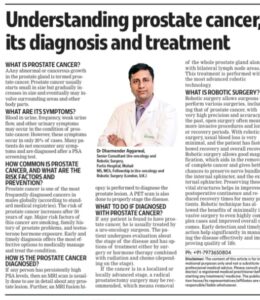
Image caption: Dr. Dharmender Aggarwal featured in The Times of India for prostate cancer awareness.
What Is Prostate Cancer?
The prostate is a small gland in the male reproductive system located below the urinary bladder and surrounding part of the urethra.
Prostate cancer occurs when cells within the prostate begin growing abnormally and form a malignant tumor.
Prostate cancer can behave differently from one patient to another. Some cancers grow slowly and may require careful monitoring, while others can be more aggressive and require timely treatment.
This is why treatment decisions should not be based on a single test alone. PSA level, clinical examination, MRI findings, biopsy results, cancer grade and stage, age, general health and patient preferences can all influence the treatment plan.
What Are the Symptoms of Prostate Cancer?
Early prostate cancer may cause no symptoms at all.
When urinary symptoms occur, they may include:
- Difficulty starting urination
- Weak urinary stream
- Frequent urination
- Increased urination at night
- Difficulty emptying the bladder
- Blood in urine or semen
Importantly, these symptoms are not specific to cancer. Benign enlargement of the prostate can produce similar symptoms.
Men should therefore avoid assuming that urinary symptoms automatically mean prostate cancer—or that the absence of symptoms means the prostate is healthy.
What Is a PSA Test?
PSA, or prostate-specific antigen, is a protein produced by prostate tissue. A PSA blood test can be an important component of prostate cancer evaluation.
An elevated PSA does not automatically mean cancer. PSA can also increase because of benign prostate enlargement, inflammation and other factors.
Similarly, PSA results need to be interpreted in the context of a patient’s age, medical history, examination and other investigations.
Men considering PSA screening should discuss its potential benefits and limitations with their doctor so that testing is individualized rather than treated as a one-size-fits-all investigation.
How Is Prostate Cancer Diagnosed?
If prostate cancer is suspected, further assessment may include:
- Clinical Evaluation
A detailed medical history, urinary symptom assessment and physical examination help establish the initial clinical picture. - PSA Testing
PSA and its pattern over time can provide useful information, although PSA alone cannot confirm prostate cancer. - Multiparametric MRI
MRI can help identify suspicious areas within the prostate and provide information useful for deciding whether further investigation is necessary. - Prostate Biopsy
When indicated, a prostate biopsy obtains tissue samples for examination by a pathologist. Biopsy determines whether cancer is present and provides important information about its characteristics. - Cancer Staging
Additional imaging may be recommended after diagnosis to determine whether cancer remains confined to the prostate or has spread elsewhere.
Does Every Prostate Cancer Need Immediate Surgery?
No.
One of the most important developments in modern prostate cancer care is recognizing that not every prostate cancer should be treated in exactly the same way.
Depending on cancer risk, age and other patient-specific factors, management options may include:
- Active surveillance
- Radical prostatectomy
- Radiotherapy
- Hormonal therapy
- Systemic cancer treatments like chemotherapy
- Combination treatment
For appropriately selected men with low-risk disease, active surveillance may avoid or delay unnecessary treatment while maintaining close monitoring.
For localized cancers that require definitive treatment, surgery may be considered.
What Is Robotic Radical Prostatectomy?
Robotic radical prostatectomy is a minimally invasive surgical procedure used to remove the prostate gland and associated cancer in appropriately selected patients with localized prostate cancer.
At Fortis Hospital Mohali, robotic uro-oncology procedures can be performed using the Da Vinci Xi robotic surgical system.
The robotic system does not independently perform the operation. The surgeon controls the instruments throughout the procedure from a specialized console.
The platform provides a magnified three-dimensional view of the surgical field and highly articulated instruments, which can be valuable when operating within the confined anatomy of the male pelvis.
What Are the Potential Benefits of Robotic Prostate Cancer Surgery?
In appropriately selected patients, robotic-assisted prostatectomy may offer benefits such as:
- Small surgical incisions
- Reduced blood loss
- Less postoperative discomfort
- Shorter hospitalization
- Faster postoperative recovery
- Magnified visualization during surgery
- Precise dissection around important anatomical structures
Cancer control remains the primary objective.
Functional outcomes such as urinary continence and sexual function are also important considerations. These outcomes vary according to cancer characteristics, age, preoperative function, anatomy, surgical factors and whether nerve preservation is oncologically appropriate. Also, these outcomes depend on whether fascial sparing, nerve sparing and sphincter sparing techniques are employed during surgery.
Patients should discuss expected cancer and functional outcomes individually with their prostate cancer surgeon.
Why Surgeon Experience Matters in Prostate Cancer Treatment
Prostate cancer surgery is not simply about removing the prostate.
The surgeon must balance several objectives, including:
- Complete cancer removal
- Appropriate surgical margins
- Preservation of the urinary sphincter
- Nerve preservation when oncologically safe
- Management of surrounding structures
- Recovery of urinary control
- Long-term cancer surveillance
For this reason, patients looking for a prostate cancer surgeon in Chandigarh, Mohali, Punjab or North India should consider cancer-specific experience and training rather than focusing only on the availability of robotic technology.
Robotic technology is a surgical tool. The surgeon remains responsible for surgical planning, decision-making and every movement during the operation.
Dr. Dharmender Aggarwal – Urology Cancer Specialist & Robotic Surgeon
Dr. Dharmender Aggarwal is Senior Consultant – Uro-Oncology & Robotic Surgery at Fortis Hospital, Mohali, with a dedicated focus on urological cancer surgery.
He completed his MCh in Urology from PGIMER Chandigarh and subsequently pursued a Fellowship in Robotic Surgery & Uro-Oncology from the Royal College of Surgeons of England at St. George’s NHS Hospital, London.
His robotic surgery credentials also include certification through the European Robotic Urology Section (ERUS), Belgium, and ORSI Academy.
Dr. Aggarwal has performed more than 950 robotic cancer surgeries involving prostate, kidney and bladder cancers using the Da Vinci Xi robotic surgical system.
In addition to clinical practice, he is involved in robotic surgery teaching and proctorship and has contributed to the development of robotic surgery programs at centers across India.
Prostate Cancer Treatment in Chandigarh & Mohali
Patients seeking prostate cancer treatment in Chandigarh can access specialized uro-oncology care in neighboring Mohali at Fortis Hospital.
The Chandigarh–Mohali region also serves patients travelling from Panchkula and different parts of Punjab, Haryana, Himachal Pradesh, Jammu & Kashmir and North India.
A prostate cancer consultation should ideally answer several questions:
- Is the diagnosis definitely prostate cancer?
- What is the grade and stage?
- Is the cancer localized or has it spread?
- Does it require immediate treatment?
- Is active surveillance appropriate?
- If treatment is necessary, what options are available?
- Is robotic radical prostatectomy suitable?
- What are the expected cancer-control and functional outcomes?
Answering these questions helps create an individualized treatment strategy.
Choosing a Prostate Cancer Doctor in Chandigarh, Mohali or Punjab
Searches such as “Best Prostate Cancer Doctor in Chandigarh,” “Best Prostate Cancer Doctor in Mohali,” and “Best Prostate Cancer Doctor in Punjab” are common among patients and families following a cancer diagnosis.
Rather than relying on the word “best” alone, patients can evaluate objective factors such as:
- Dedicated uro-oncology specialization
- Formal robotic surgery training
- Experience specifically with prostate cancer
- Volume of robotic cancer surgery
- Experience with nerve-sparing techniques
- Access to modern imaging and pathology
- Multidisciplinary cancer care
- Transparent discussion of treatment alternatives
- Structured follow-up after treatment
These factors provide a more meaningful basis for selecting a specialist.
Robotic Prostate Cancer Surgery in Chandigarh, Mohali & Punjab
Patients searching for the best robotic surgeon for prostate cancer in Chandigarh or Mohali are often trying to identify a surgeon with substantial experience in robotic radical prostatectomy.
Dr. Dharmender Aggarwal provides robotic uro-oncology care at Fortis Hospital Mohali using the Da Vinci Xi platform.
Patients from Chandigarh, Mohali and other parts of Punjab can be evaluated to determine whether robotic prostatectomy is suitable for their individual cancer.
Importantly, robotic surgery is not automatically the correct treatment for every patient with prostate cancer. Treatment should be selected according to the cancer’s risk category, stage and individual circumstances.
Prostate Cancer Treatment for Patients Across North India
Patients from Punjab, Haryana, Himachal Pradesh, Jammu & Kashmir and other areas frequently travel to the Chandigarh–Mohali healthcare region for specialized treatment.
For someone searching for a prostate cancer surgeon in North India or the best robotic surgeon for prostate cancer in North India, a specialist consultation can help clarify both surgical and non-surgical treatment options.
The objective should be to select the treatment most appropriate for the individual cancer—not simply the newest technology.
The Times of India Feature: Creating Greater Prostate Cancer Awareness
Public awareness can play an important role in earlier evaluation and informed cancer care.
Dr. Dharmender Aggarwal’s prostate cancer awareness feature in The Times of India helps bring reliable information about prostate cancer into the public conversation and encourages men to understand risk, diagnosis and available treatment options.
For patients, accurate information can reduce confusion and make discussions with their treating specialists more productive.
Frequently Asked Questions About Prostate Cancer
- Is prostate cancer curable?
Many localized prostate cancers can be treated successfully. Individual prognosis depends on factors such as cancer grade, stage, PSA, tumor characteristics and overall health. - Does a high PSA always mean prostate cancer?
No. An elevated PSA can occur for several reasons and does not by itself confirm cancer. Further clinical assessment may be necessary. - Does every patient with prostate cancer need surgery?
No. Treatment depends on the cancer’s characteristics and the individual patient. Options can include active surveillance, surgery, radiotherapy, hormonal treatment and other systemic therapies. - What is robotic prostate cancer surgery?
Robotic radical prostatectomy is a minimally invasive operation in which the surgeon uses a robotic surgical platform to remove the prostate and cancer. The surgeon controls the robotic instruments throughout the procedure. - Is robotic prostate cancer surgery available in Mohali?
Yes. Robotic uro-oncology procedures are available at Fortis Hospital Mohali. Dr. Dharmender Aggarwal performs robotic cancer surgery using the Da Vinci Xi robotic platform. - How should I choose the best prostate cancer doctor in Chandigarh or Mohali?
Consider objective factors such as dedicated uro-oncology training, prostate cancer experience, robotic surgery credentials, surgical volume, access to multidisciplinary care and the specialist’s approach to discussing all appropriate treatment alternatives. - Who should I consult for prostate cancer treatment in Punjab?
Men diagnosed with prostate cancer can consider consulting a uro-oncology specialist who routinely manages prostate cancer and can discuss both surgical and non-surgical treatment pathways. - What should I consider when looking for the best robotic surgeon for prostate cancer in Punjab?
Relevant considerations include formal robotic training, experience specifically with robotic radical prostatectomy, overall cancer-surgery experience, hospital infrastructure and discussion of cancer-control, continence and sexual-function outcomes. - Can patients from North India consult Dr. Dharmender Aggarwal for prostate cancer?
Dr. Dharmender Aggarwal treats uro-oncology patients at Fortis Hospital Mohali, including patients travelling from Chandigarh, Punjab and other parts of North India.
Takeaway
A prostate cancer diagnosis does not automatically mean that every patient requires the same treatment. Accurate diagnosis, risk assessment and staging are essential before deciding between surveillance, surgery, radiotherapy or systemic treatment.
When surgery is appropriate, modern robotic technology can enable minimally invasive radical prostatectomy, but technology should be combined with specialized uro-oncology training and substantial surgical experience.
Through his prostate cancer awareness feature in The Times of India, Dr. Dharmender Aggarwal continues to promote greater understanding of prostate cancer, timely evaluation and evidence-based treatment among patients across Chandigarh, Mohali, Punjab and North India.